


Photo credits
- Most crests are public-domain club marks (Wikimedia Commons). Attribution where required:
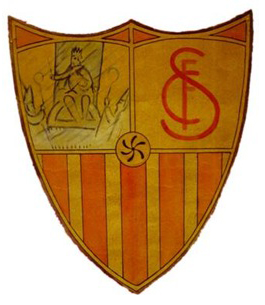
- Sevilla 1921 crest — MPinillos · CC BY-SA 4.0
- PSV emblem — Megameul · CC BY-SA 4.0
- Olympique Lyonnais mark — Islam90 · CC BY-SA 4.0
- Club América crest — Patila · CC BY-SA 3.0
Football Club Crest Quiz — Rules & What Counts
Thirty-three crests, no club names to lean on — just the badge. From the San Siro to La Bombonera, this quiz shows the marks of the world's most famous football clubs and asks you to type who they belong to. Wherever a crest spelled out its club's name, the lettering has been stripped from the artwork, so you're recognizing the mark itself.
The spread is deliberately global: Serie A and the Bundesliga anchor the board, but Brazil, Argentina, Turkey, Greece, Mexico, Saudi Arabia, and MLS all field clubs — so a Champions-League-only fan will hit a wall somewhere around the Copa Libertadores.
A few badges are classic earlier versions of a club's crest — Arsenal's mid-century cannon, Sevilla's 1921 shield, Benfica's original eagle — which turns those cards into a small history test: same club, older clothes.
How to play
- Just start typing — answers are checked on every keystroke, no submit button. A correct club name flips its card instantly.
- Short names count: "Juve", "Inter", "Boca", "BVB", and "Gala" all work, and accents are optional — "Monchengladbach" is accepted, mercifully.
- Each solved card reveals the club's country, so a finished board doubles as a map of world football.
- Crests sit on a light backing in both themes, so dark linework stays visible in dark mode.
- The count-up timer starts at your first keystroke; Give Up reveals every badge you missed, and progress autosaves as you go.
What counts in this quiz
- 33 clubs from 13 countries — European giants, South American icons, and the modern money clubs of Saudi Arabia and MLS.
- Every crest is a freely licensed (public-domain or Creative-Commons) version of the club's badge, which is also why some appear as classic older designs rather than this season's rebrand.
- Written club names were removed from the artwork; monograms and initials that are the design itself — ACM, CABJ, BVB, PSV — stay, because without them there'd be no badge left.
- Both current crests and beloved earlier ones count as the same club — you're naming the club, not the design year.
What's not included — and why
- Some very big names are missing on purpose: clubs whose crest has no freely licensed version anywhere — most of the Premier League, Barcelona, Atlético Madrid, Porto, Celtic, and Rangers among them — couldn't be included without ripping copyrighted artwork.
- National-team badges aren't here either: this quiz is clubs only.
- Stadiums, kits, and nicknames aren't answers — only the club name (or its accepted short forms) counts.
Good to know
- Juventus's minimalist double-J mark from 2017 was one of football's most controversial rebrands — half design award, half fan revolt.
- Boca Juniors' blue and gold came from a bet: legend says the club took its colours from the flag of the next ship to sail into the port of Buenos Aires — a Swedish one.
- Feyenoord and Sporting CP have barely changed their crests in a century, while AC Milan's badge still carries the red cross of the city of Milan.
- Al-Nassr's global fame spiked overnight in 2023 for reasons that have nothing to do with the crest — and everything to do with the #1 card of Trivi's highest-earning footballers quiz.