Which element has these shells?
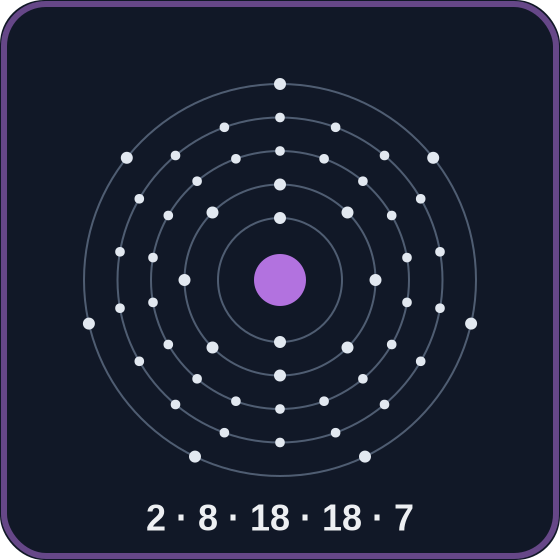 Which element has these shells?
Rules & what counts
Electron Shell Quiz: Rules & What Counts
An atom's electrons sit in shells around the nucleus. The first shell holds up to 2, the second up to 8, the third up to 18. The number of shells is the row of the periodic table, and the electrons in the outer shell are the column.
The game shows a shell diagram with no name and no number. You type the element it belongs to.
The counts are printed along the bottom of each picture, inner shell first, so you never have to count 32 dots on a ring.
The run has three lives. A perfect run is 20 diagrams.
How to play
- The picture shows the nucleus, one ring per shell, and the electrons of that shell on the ring.
- Type the name of the element. The answer bar lists the names it knows.
- A right answer flashes the picture green and deals the next diagram.
- A wrong answer costs one life and names the element, with its symbol, its atomic number and its shells.
- The run ends when the three lives are gone, or when you have named 20 diagrams.
- Your score is the number of diagrams you named.
What counts in this quiz
- The pool is the elements most people can name, a little over half the table.
- The shells are the real ground-state structures, not what the filling rule predicts. So chromium is 2-8-13-1 and palladium is 2-8-18-18.
- Every diagram is drawn at the same size, whether the element has one shell or seven. The size of the picture is never a clue.
- The nucleus is blank. Its proton count is the atomic number, and that would give the answer away.
What's not included, and why
- The lanthanides and the actinides are not in the pool. Erbium and thulium differ by one electron in an inner shell, so the question would be a coin flip rather than a question about the table.
- The laboratory elements above uranium are not in the pool either.
- The diagram is the shell model, which is the model school chemistry uses. It does not show orbital shapes.
Good to know
- The last shell count tells you the group. Every element with one electron in its outer shell is in the first column, from hydrogen to francium.
- A full outer shell is why the noble gases do almost nothing: helium is 2, neon is 2-8, argon is 2-8-8.
- Potassium is 2-8-8-1, not 2-8-9. The fourth shell starts before the third one is full, which is why the transition metals exist.
- Palladium is the only element with an empty outer shell in its ground state: 2-8-18-18, and nothing beyond.